
Aquarium Stocking Calculator
Overstocking is one of the most common reasons aquariums struggle. Enter your tank’s size and the fish you plan to keep, and the calculator estimates how full the tank is using adult sizes and a bioload factor for each species, flags fish that need bigger tanks or larger groups, and highlights temperature and temperament mismatches.
- Free to use
- No sign-up
- Runs in your browser
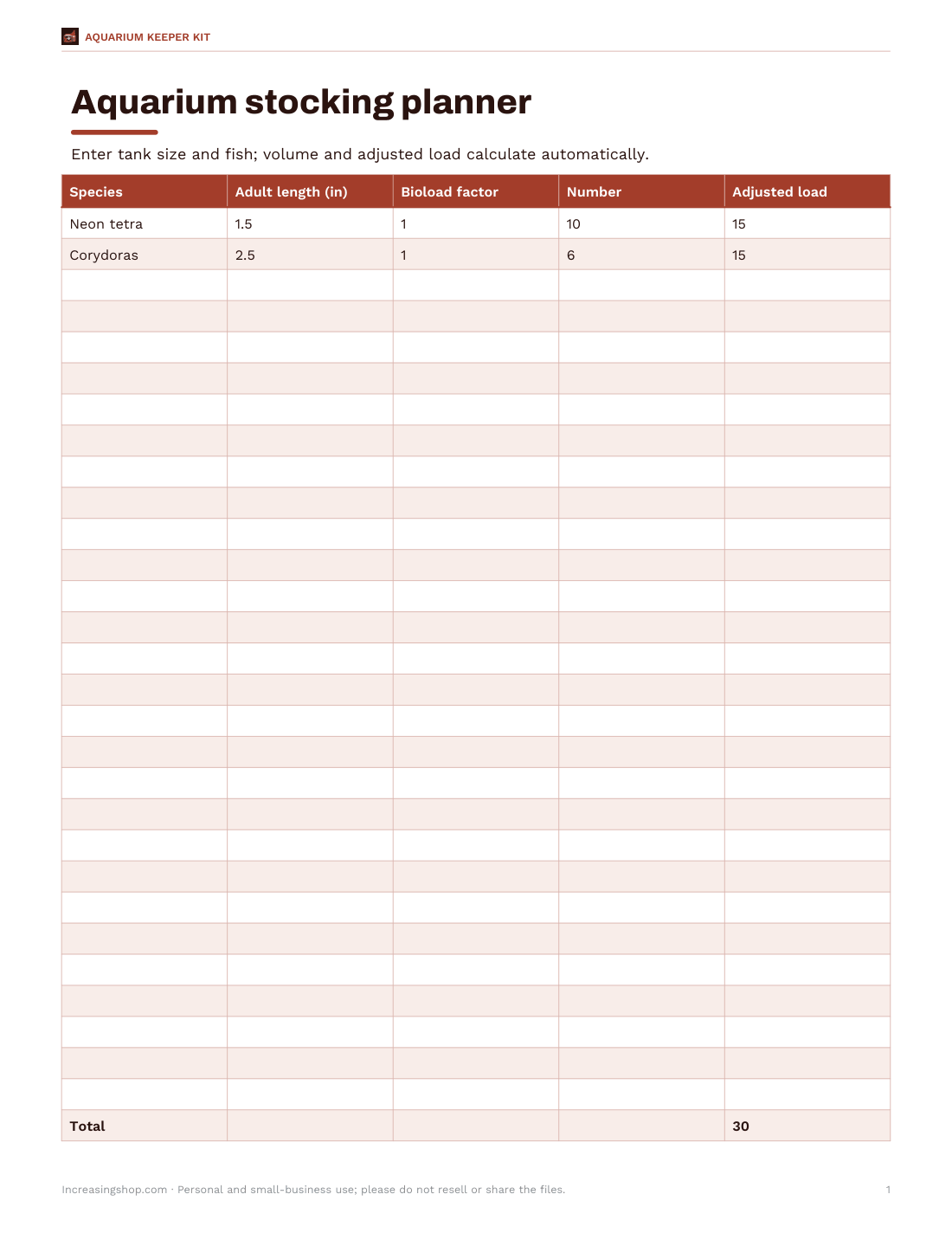
Aquarium stocking calculator
Aquarium Keeper Kit
Aquarium keeper kit: stocking planner workbook, water test log with target ranges, weekly and monthly maintenance schedule, fish compatibility notes and a new-tank cycling checklist.
- Stocking planner (XLSX)
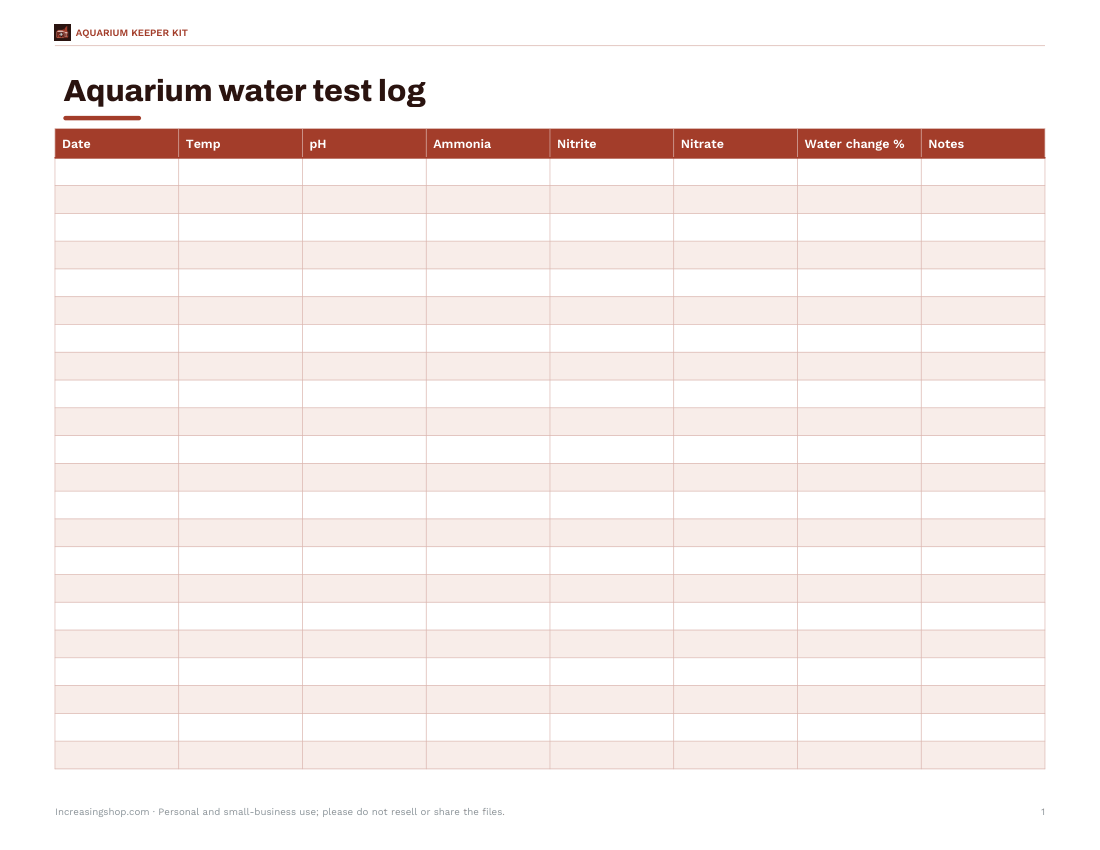
- Water test log (PDF, XLSX)
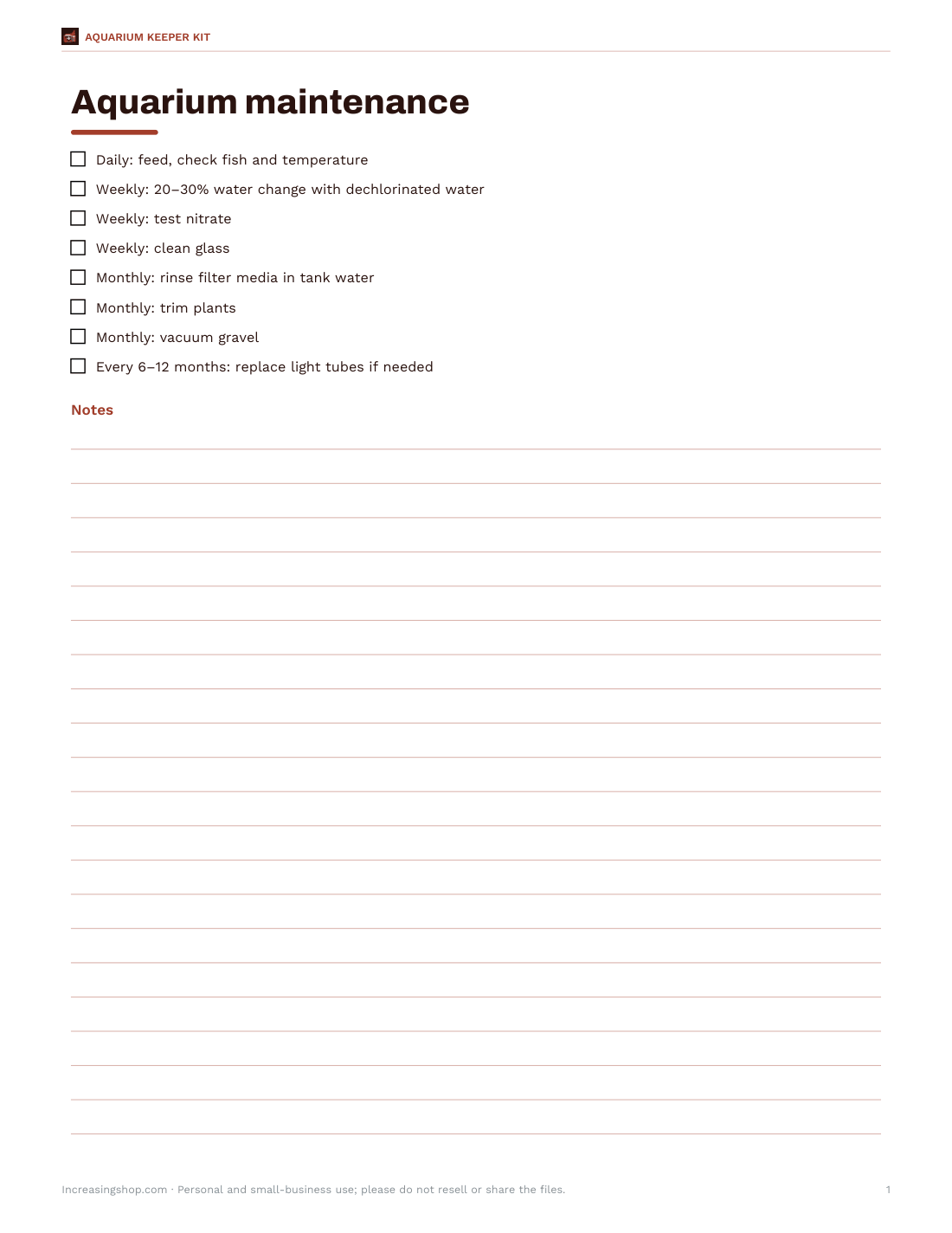
- Maintenance schedule (PDF, DOCX)
- Cycling checklist (PDF, DOCX)
Formats: XLSX, PDF, DOCX. Instant download after payment (link valid 72 hours, up to 5 downloads). AI-assisted: the templates were drafted with AI help and reviewed and laid out before publishing.
$5.00 USD, one-time 4 files · about $1.25 each
- Instant download
- 7-day refund
- Secure checkout by Stripe
7-day money-back guarantee. Full refund within 7 days of purchase, even after you download.
Free sample: Aquarium Stocking Planner (PDF, 58 KB)
Full refund within 7 days — see the refund policy and license.
Free printables
Single sheets you can print right now, no sign-up. The full pack adds every sheet in one download plus the editable files.
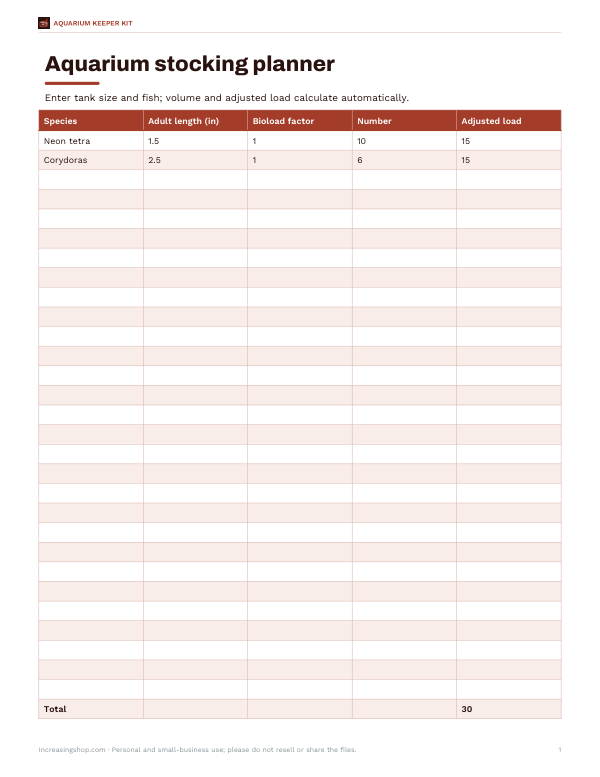 Aquarium Stocking Planner Printable
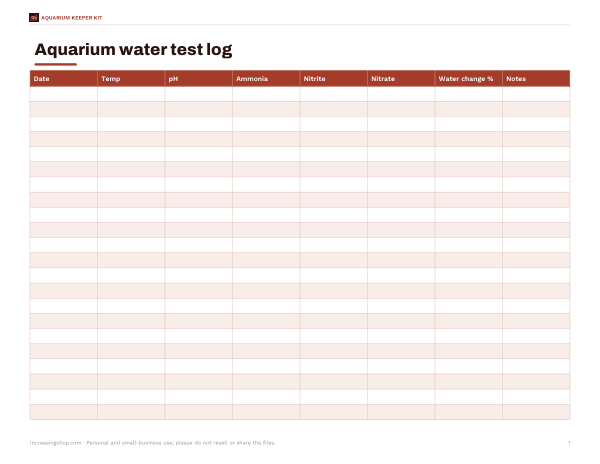 Printable Aquarium Water Test Log
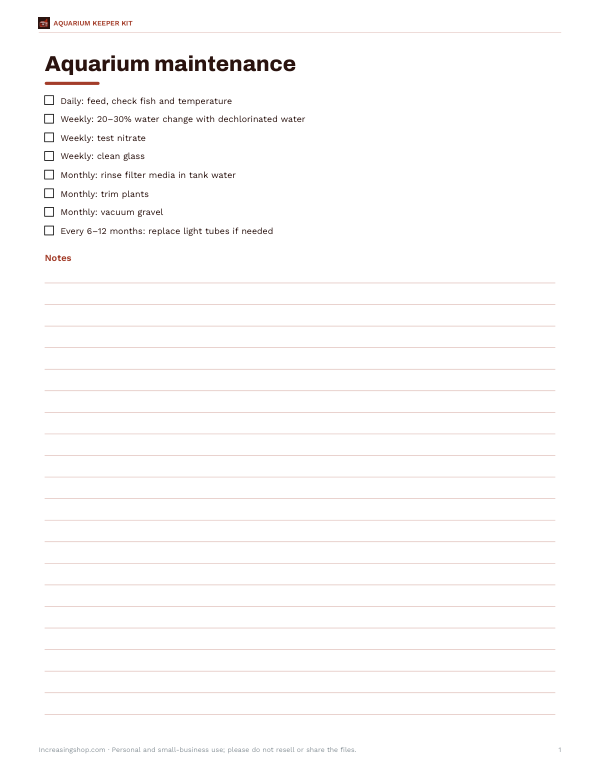 Printable Aquarium Maintenance Schedule
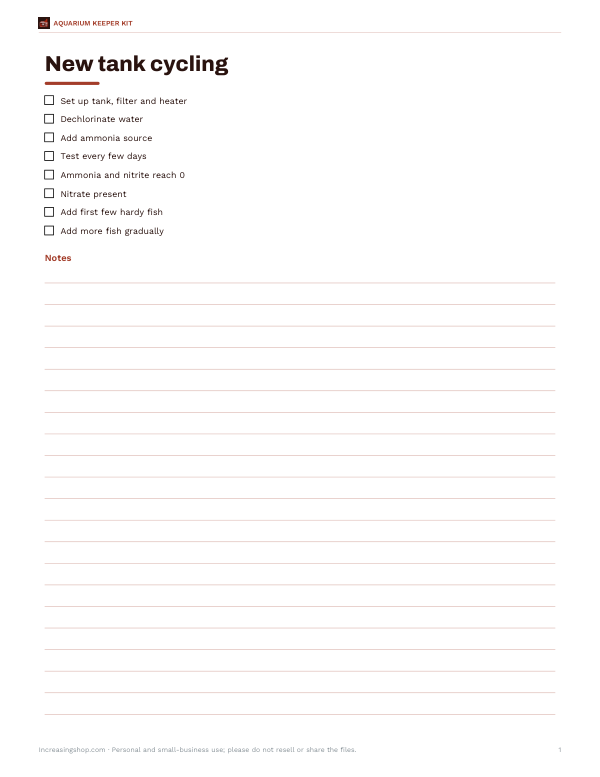 Printable New Tank Cycling Checklist
Why the “inch per gallon” rule falls short
The old guideline of one inch of fish per gallon of water is easy to remember but treats all fish the same. A 10-inch plecostomus produces far more waste than ten 1-inch tetras, deep-bodied fish carry more mass than slim ones, and some fish need to swim in groups or need more room to turn around. This calculator uses the adult length of each species multiplied by a bioload factor for body shape and waste production (below 1 for small, slim fish; 2–3 for heavy-bodied, messy fish), compares the total with the tank’s usable water volume, and adjusts for filtration and live plants.
Fish in the calculator
| Species | Adult size (in) | Min. tank (gal) | Min. group | Notes |
|---|---|---|---|---|
| Neon tetra | 1.5 | 10 | 6 | Peaceful; school of 6+; 22–26 °C |
| Harlequin rasbora | 2 | 10 | 6 | Peaceful schooling fish |
| Zebra danio | 2 | 20 | 6 | Active; tolerates cooler water |
| Cherry barb | 2 | 20 | 6 | Peaceful barb |
| Guppy | 2 | 10 | 3 | Livebearer; breeds readily |
| Platy | 2.5 | 10 | 3 | Hardy livebearer |
| Corydoras catfish | 2.5 | 20 | 6 | Bottom dweller; keep in groups |
| Otocinclus | 2 | 20 | 4 | Algae grazer; needs a mature tank |
| Honey gourami | 2 | 10 | 1 | Peaceful gourami |
| Betta (male) | 3 | 5 | 1 | One male per tank; long fins |
| Tiger barb | 3 | 30 | 6 | Can nip fins; keep in groups |
| Dwarf gourami | 3.5 | 20 | 1 | Semi-aggressive males |
| Molly | 4 | 30 | 3 | Prefers harder water |
| Kuhli loach | 4 | 20 | 5 | Slender, shy, groups |
| Swordtail | 5 | 30 | 3 | Active livebearer |
| Bristlenose pleco | 5 | 30 | 1 | Heavy waste producer |
| Angelfish | 6 | 30 | 1 | Tall tank; may eat tiny fish |
| Fancy goldfish | 7 | 30 | 1 | Coldwater; very high bioload |
Sizes and minimum tank sizes are typical guidance for home aquariums; individual fish and sources vary. Research each species’ water parameters before buying.
How to use the calculator
- Enter the tank’s internal length, width and height in inches.
- Choose your filtration strength and whether the tank is planted.
- Add each species and the number you plan to keep.
- Read the stocking percentage and warnings.
- Aim for under about 80% so there is margin for growth and mistakes.
What affects how many fish a tank can hold
- Filtration — biological filtration processes ammonia and nitrite; a strong filter supports more fish.
- Maintenance — regular partial water changes remove nitrate.
- Plants — live plants absorb nitrogen compounds.
- Surface area — wide, shallow tanks exchange oxygen better than tall, narrow ones.
- Temperament and territory — some fish need space more than water volume.
- Adult size — always plan for full-grown fish, not the size in the shop.
Worked example
A 30 × 12 × 16 inch tank holds about 25 gallons (95 litres) — roughly 21 gallons of water after gravel and decor. With a standard filter and live plants, ten neon tetras, six corydoras and one honey gourami come to roughly two-thirds stocking: comfortable, with room for a few more small, peaceful fish. Adding an angelfish would trigger a warning that it may eat the neons as it grows.
Signs a tank is overstocked
- Ammonia or nitrite readings above zero in an established tank.
- Nitrate rising quickly between water changes.
- Fish gasping at the surface or hiding constantly.
- Frequent fighting, torn fins or bullying.
- Cloudy water and algae outbreaks despite regular maintenance.
If you see these signs, reduce feeding, increase water changes and consider rehoming some fish or upgrading the tank and filter.
Choosing peaceful community fish
For a first community tank, choose small, peaceful species that like similar water: a school of tetras or rasboras for the middle of the tank, a group of corydoras for the bottom, and one centrepiece fish such as a honey gourami. Avoid mixing fin-nippers with long-finned fish, and keep coldwater species like goldfish separate from tropical fish.
Stocking a new tank
Cycle the tank before adding fish, so beneficial bacteria can process waste — this usually takes several weeks. Add fish gradually, a few at a time, starting with hardy species, and test ammonia, nitrite and nitrate regularly. Quarantining new fish in a separate tank for a few weeks reduces the risk of introducing disease.
Tank sizes and volumes
| Tank (L × W × H in) | US gallons | Litres |
|---|---|---|
| 20 × 10 × 12 | 10 | 38 |
| 24 × 12 × 16 | 20 | 76 |
| 30 × 12 × 16 | 25 | 95 |
| 36 × 12 × 16 | 30 | 113 |
| 36 × 18 × 16 | 45 | 170 |
| 48 × 13 × 21 | 55 | 208 |
| 48 × 18 × 24 | 90 | 340 |
Volumes are gross (glass-to-glass); subtract about 10–15% for substrate and decor.
What the template pack includes
An aquarium stocking planner workbook, a water test log, a maintenance schedule, a fish compatibility notes sheet and a new-tank cycling checklist.
Frequently asked questions
How many fish can I put in a 20-gallon tank?
It depends on species; for small community fish, often 10–15 small fish with good filtration.
Is one inch per gallon accurate?
Only as a rough guide for small, slim fish; bioload and adult size matter more.
What is bioload?
The amount of waste a fish produces, which the filter and water changes must handle.
Why do some fish need groups?
Schooling fish like tetras and corydoras are stressed when kept alone or in pairs.
How do I calculate aquarium volume?
Length × width × height in inches ÷ 231 gives US gallons.
Do plants really help?
Yes, live plants absorb nitrogen compounds and add some margin, but they don’t replace water changes.
How often should I do water changes?
Commonly 20–30% weekly for a community tank, adjusted by nitrate readings.
Is my data stored?
No, it runs in your browser.